
An unexpected ambulance ride brings vital medical care during a sudden physical crisis. Knowing how Medicare handles these critical trips protects both your health and your personal savings.
Original Medicare offers dependable coverage for emergency ground and air transport when you face serious distress. Understanding these specific healthcare policies ensures you can focus entirely on your physical recovery.
Many older adults worry about high bills when calling for urgent roadside assistance. This comprehensive guide outlines the vital rules governing your emergency transport benefits and your non-emergency healthcare rights.
Understanding the Basics of Medicare Ambulance Coverage for Seniors
Medicare ambulance coverage provides essential peace of mind when severe illness or physical injury strikes without warning. It ensures that trained medical professionals can reach you quickly during life-threatening events.
Many older adults worry that calling for medical transport will lead to unmanageable household expenses. However, federal guidelines establish clear protections to keep these lifesaving services accessible and affordable.
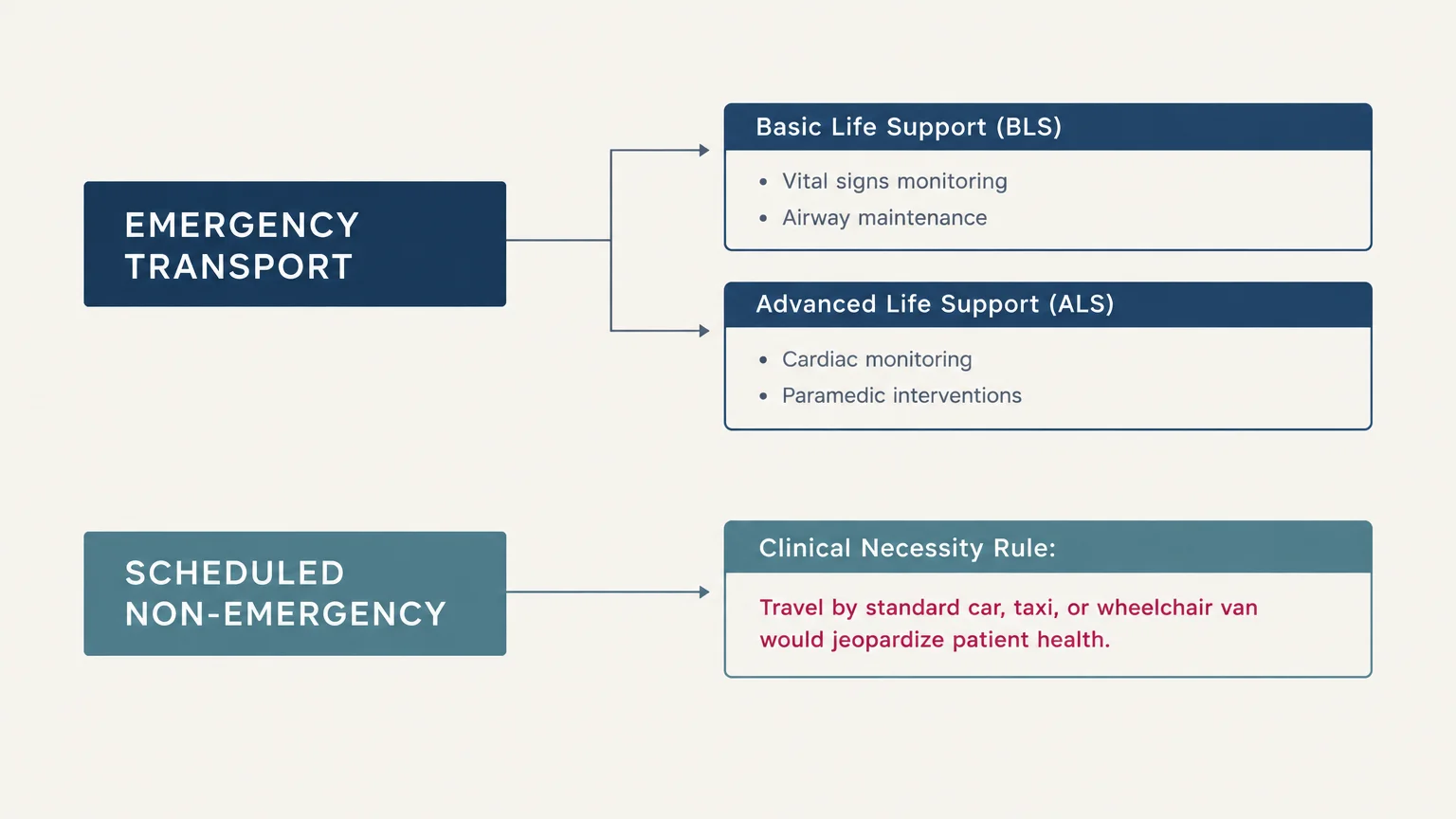
Medicare separates transportation services into two primary categories: emergency responses and scheduled non-emergency trips. Each category operates under distinct billing rules, documentation standards, and clinical necessity guidelines.
Emergency transport delivers immediate medical intervention when a sudden injury or illness threatens your health. Paramedics assess your vital signs, administer urgent therapies, and monitor your physical condition en route to an emergency department.
Non-emergency ambulance trips assist seniors who live with severe, ongoing health challenges. These individuals require continuous clinical supervision or specialized equipment that standard personal vehicles cannot provide.
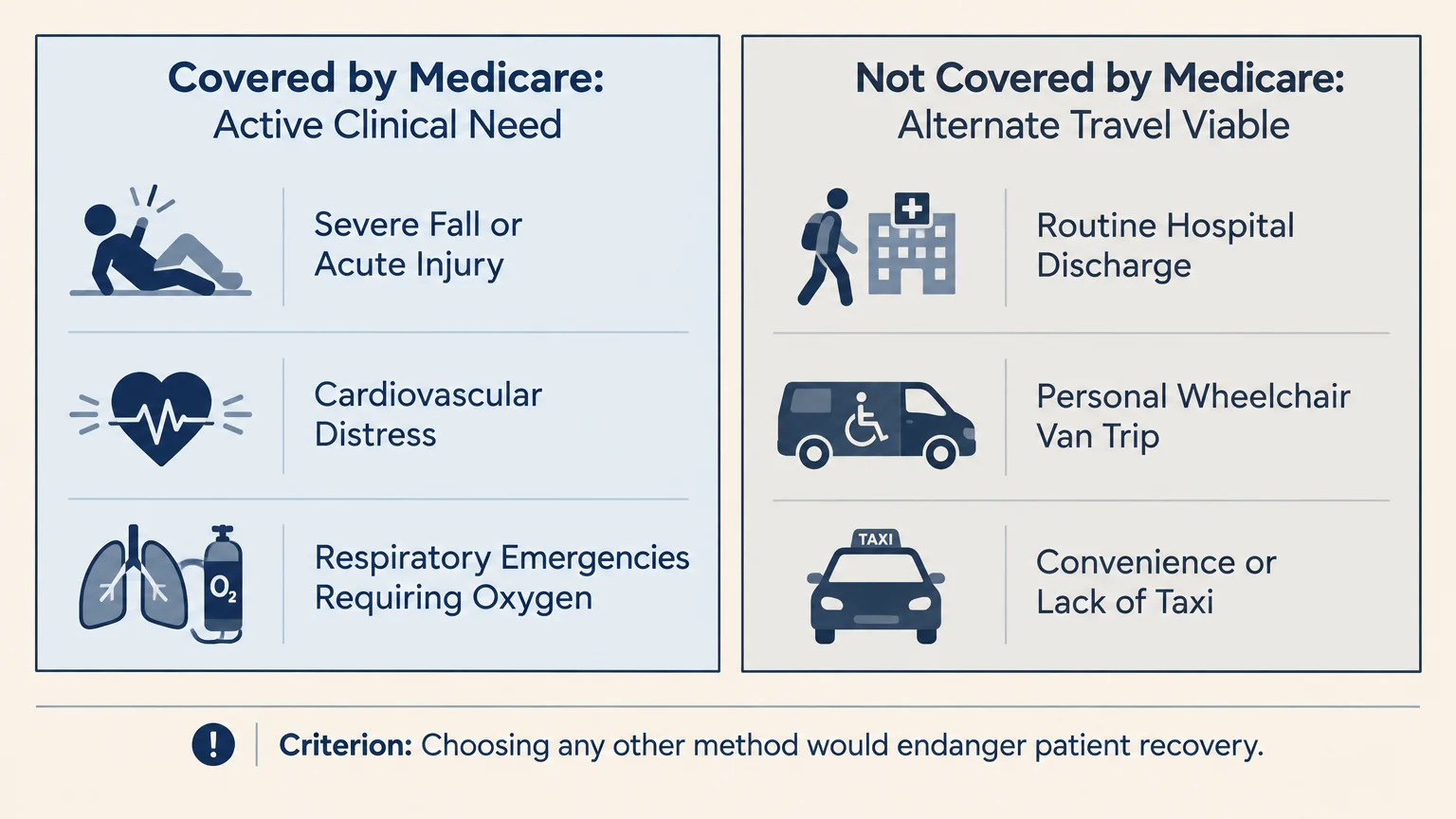
Understanding the concept of medical necessity remains the foundation of all Medicare transport decisions. The program only approves claims when choosing any other method of travel would jeopardize your overall well-being.
If a patient can safely travel in a taxi, car, or wheelchair van, Medicare will not approve the ride. The federal program reserves ambulance benefits exclusively for individuals requiring active medical care during transit.
Older adults frequently face unique medical conditions that make specialized transport vital. Fall injuries, cardiovascular distress, and respiratory illnesses often demand immediate intervention from certified emergency medical technicians.
During an emergency call, local dispatchers determine whether you require Basic Life Support or Advanced Life Support. Both service levels qualify for coverage as long as your clinical condition justifies the response.
Basic Life Support provides emergency transportation alongside non-invasive monitoring and basic airway support. In contrast, Advanced Life Support units carry advanced medications, cardiac monitors, and paramedics trained in complex interventions.
Learning your coverage details beforehand allows you to react calmly during a distressing crisis. You can request emergency help without hesitating over administrative rules or financial uncertainties.
Being proactive about your healthcare benefits helps you protect your retirement savings. You gain complete confidence knowing exactly how your coverage operates before you ever dial for help.

Practical Tips for a Healthier, Happier Life
Navigating the healthcare system feels much easier when you understand your rights and coverage parameters. The following eight rules demystify how Medicare evaluates, approves, and reimburses ambulance services.
1. Meeting the Medical Necessity Standard
Does medicare cover ambulance rides whenever you feel unwell? Medicare only approves emergency transport medicare claims when using any other type of vehicle would actively endanger your life or health.
Severe medical situations automatically satisfy this federal requirement. Conditions like suspected strokes, chest pains, sudden unconsciousness, or severe bleeding require advanced life support that ordinary vehicles lack.
Paramedics perform critical diagnostics and administer emergency treatments while driving toward the hospital. This continuous medical oversight protects your physical stability when every passing minute counts.
If your condition allows safe travel in a personal automobile, Medicare will deny the ambulance claim. The program expects beneficiaries to reserve emergency transport for genuine clinical emergencies.
You must never hesitate to call for an ambulance during a suspected health crisis. First responders assess your physical condition immediately upon arrival and document your medical necessity for Medicare examiners.
Keep a detailed list of your medical conditions and current medications near your front entryway. Giving this paper to paramedics ensures they document your complex health history accurately for insurance auditors.
First responders record detailed clinical trip notes documenting why you could not sit safely in an ordinary car. These detailed field observations serve as vital proof during Medicare’s claim approval process.
2. Managing Part B Deductible and Coinsurance Costs
Most emergency ambulance rides fall under your Medicare Part B outpatient medical insurance. You must pay an annual Part B deductible of $283 before Medicare begins paying for covered services.
After you satisfy that $283 deductible, Medicare pays 80% of the approved transport charge. You remain responsible for paying the remaining 20% coinsurance out of your own funds.
Federal regulations strictly require all Medicare-participating ambulance companies to accept assignment. This rule means the transport supplier must accept the Medicare-approved reimbursement rate as full payment.
The ambulance company cannot charge you extra fees beyond your standard deductible and 20% coinsurance. This vital consumer safeguard keeps the ambulance costs seniors pay predictable and fair.
If you carry a supplemental Medigap policy, it generally covers your 20% coinsurance responsibility. Checking your supplemental policy details annually ensures you maintain complete financial protection against unexpected medical bills.
Medicare pays a base rate for the transport service plus a fixed rate for each covered mile. The ambulance supplier itemizes these charges clearly on your Medicare Summary Notice for easy review.
Always review your Medicare Summary Notice whenever you receive emergency transport services. Verifying that the supplier billed the correct approved rate prevents overcharges and administrative errors.
3. Understanding Inpatient Transfers Under Part A
Some ambulance trips do not fall under outpatient Part B coverage rules. Instead, Medicare covers certain specialized transfers under your Part A hospital insurance benefits.
If you are formally admitted as an inpatient to a hospital or Skilled Nursing Facility, Part A applies. The transfer must move you to another medical facility to receive specialized clinical care.
Under these circumstances, your transport links directly to your inpatient stay rather than outpatient services. The standard Medicare Part A deductible is $1,736 per benefit period.
If you have already met your $1,736 deductible for that hospitalization, you typically pay nothing extra. The sending facility handles the transport arrangements directly as part of your inpatient care package.
A benefit period begins the day you are admitted to a hospital and ends when you remain out of inpatient care for sixty consecutive days. Understanding this timeline helps you track your deductible obligations accurately.
Always ask the hospital staff to clarify your formal admission status during any facility stay. Knowing whether you are an admitted inpatient or under outpatient observation clarifies your potential transport expenses.
Inpatient transfers guarantee that you travel safely between medical centers under professional supervision. They provide continuous clinical oversight without adding separate outpatient coinsurance bills to your account.
4. Adhering to the Closest Appropriate Facility Mandate
Medicare enforces clear geographic boundaries on where an ambulance can transport you during an emergency. The program will only pay for transport to the closest appropriate facility capable of treating your condition.
An appropriate medical facility possesses the specialized equipment, medical staff, and surgical capacity necessary to manage your illness. A neighborhood clinic without critical care units would not qualify for a trauma patient.
You hold the personal right to request a hospital located farther away from the scene. However, making that choice triggers distinct financial obligations under established medicare ambulance rules.
If you request a distant hospital, Medicare calculates reimbursement based solely on the mileage to the nearest equipped facility. You become fully responsible for paying the extra mileage costs for the additional distance.
Those extra travel miles can add significant out-of-pocket expenses to your final medical bill. Allowing paramedics to transport you to the closest appropriate hospital preserves your health and minimizes unexpected costs.
If your local hospital lacks specialized burn, stroke, or cardiac units, paramedics will bypass it for an equipped regional center. In those clinical scenarios, Medicare covers the entire trip distance because the farther facility is deemed the closest appropriate choice.
Discuss regional hospital capabilities with your family physician during your routine checkups. Knowing which local centers excel in cardiac, stroke, or orthopedic care helps you make informed choices during emergencies.
5. Securing a Physician Certification Statement for Non-Emergency Care
Scheduled non-emergency ambulance rides require strict clinical documentation before Medicare approves coverage. Your physician must officially confirm that traveling by any other vehicle would compromise your physical health.
The ambulance supplier must secure a written Physician Certification Statement from your doctor before providing scheduled rides. This formal document outlines your specific physical impairments and medical supervision needs.
Qualifying reasons often include bed confinement, severe muscular weakness, or the ongoing need for intravenous medications. Needing assistance with a standard wheelchair does not qualify you for covered ambulance services.
In unscheduled non-emergency scenarios, Medicare allows the transport provider a limited administrative window. The ambulance supplier must obtain the signed statement from your doctor within 48 hours after the transport occurs.
If your physician fails to sign the required paperwork within that timeframe, Medicare will reject the claim. In that scenario, the transport company may attempt to hold you responsible for the bill.
Keep regular appointments with your doctor so they can document any progressive changes in your mobility. A well-documented clinical chart makes completing the required certification statement fast and seamless for your physician.
Always coordinate planned medical transport through your doctor’s administrative office well ahead of time. Confirming that your physician completed the certification paperwork protects you from unexpected billing disputes.
6. Navigating Repetitive Scheduled Transport and Prior Authorization
Some seniors require frequent, repetitive medical treatments to manage chronic conditions like kidney failure or cancer. When mobility impairments prevent regular travel, individuals rely on repetitive scheduled non-emergency transport.
Medicare defines repetitive transport as 3 or more round trips in a 10-day period. The rule also applies if you take at least 1 round trip per week for 3 weeks or more.
Nationwide regulations require ambulance companies to participate in the Repetitive Scheduled Non-Emergent Ambulance Transport model. Under this federal program, suppliers must submit prior authorization requests before providing recurring rides.
If the transport company fails to obtain voluntary prior authorization before your 4th round trip, Medicare acts quickly. The program stops processing payments and places all future claims under mandatory prepayment medical review.
Prepayment reviews can cause frustrating delays and interrupt your ongoing healthcare appointments. Fortunately, your transport provider carries the primary responsibility for submitting this prior authorization paperwork directly to Medicare.
Prior authorization decisions typically arrive within several business days after submission. Once Medicare grants approval, your recurring transportation coverage remains secure for the entire authorized timeframe.
Speak directly with your transport coordinator before you embark on your fourth scheduled round trip. Confirming that your provider secured prior authorization ensures your essential treatment rides continue without interruption.
7. Protecting Your Rights with the Advance Beneficiary Notice
Medicare protects seniors from surprise non-emergency transport costs through formal notification rules. A transport company must issue an Advance Beneficiary Notice of Noncoverage if they believe Medicare will deny the claim.
This written notice clearly explains that Medicare will likely refuse to pay for the scheduled ride. It also informs you that you must pay 100% of the cost if you decide to proceed.
Receiving this notice empowers you to make an informed financial decision before the ride begins. You can choose to accept the private expense or seek alternative community transit options.
Paramedics will never hand you an Advance Beneficiary Notice during a life-threatening medical emergency. Federal regulations strictly forbid providers from issuing financial disclaimers or demanding payment guarantees during acute crises.
If a transport provider pressures you to sign financial waivers during an urgent emergency, prioritize your personal care. Emergency teams must provide immediate life support without conditioning care on advance billing agreements.
The notice offers specific checkboxes allowing you to either proceed with private billing or decline the transport entirely. Take your time to review these options carefully before signing any non-emergency paperwork.
For scheduled non-emergency transfers, read all paperwork carefully before providing your signature. Asking for an upfront cost estimate ensures you avoid surprises and protect your personal budget.
8. Following Air Ambulance Protocols and Balance Billing Protections
Severe medical crises in remote locations may require air transport rather than ground transit. Medicare Part B covers emergency rotary-wing helicopter and fixed-wing airplane transport under specific clinical conditions.
Air transport qualifies for coverage only if ground ambulances cannot physically reach your location. It also qualifies when severe travel distances or traffic obstacles prevent you from receiving timely lifesaving care.
When an air transport claim meets these strict federal standards, you pay the standard Part B 20% coinsurance. Medicare pays the remaining 80% of the approved amount once you meet your deductible.
Many older adults worry about catastrophic surprise bills from out-of-network medical flight companies. Fortunately, Original Medicare beneficiaries enjoy built-in federal protections against aggressive balance billing practices.
All Medicare-enrolled ambulance suppliers must accept assignment for covered emergency transports. This statutory requirement prevents flight companies from billing you for any amounts above the approved Medicare rate.
Flight crews communicate directly with ground physicians to determine whether air transport is medically justified. Their expert assessment guarantees that you receive the highest level of care during severe health emergencies.
You can rest assured that covered emergency air flights will not lead to devastating surprise invoices. Federal law shields your retirement finances while ensuring you receive rapid access to advanced trauma care.
Important Safety Precautions to Keep in Mind
Your immediate personal health must always take precedence over billing concerns during an emergency. Never delay dialing 911 because you worry about potential out-of-pocket costs or insurance deductibles.
Emergency medical technicians possess specialized training to stabilize severe physical trauma and acute cardiac events. Delaying emergency transport can cause irreversible medical damage or even cost you your life.
Be aware that Medicare explicitly excludes ambulette and standard wheelchair van services from coverage. These specialized vans provide accessible physical transportation, but they lack licensed clinical staff and medical monitoring gear.
If you book an ambulette for routine appointments, you must cover those transportation costs privately. Check with local senior community centers or volunteer organizations for affordable local transit options.
Keep your primary Medicare card and supplemental insurance details stored together in an easily accessible location. Providing these cards promptly to hospital billing specialists prevents administrative billing errors.
Post an emergency contact sheet on your refrigerator listing your doctors, family members, and medical conditions. First responders often look there first when assessing an individual who cannot speak clearly.
Appoint a trusted family member or personal healthcare proxy to assist you with paperwork after an emergency. Having an advocate review your medical bills helps you identify duplicate charges and incorrect claim submissions.
If Medicare denies an ambulance claim, remember that you maintain the legal right to file an appeal. Many initial claim denials stem from missing paperwork or incomplete clinical notes from the transport team.
You can request detailed clinical records from the hospital emergency department to support your formal appeal. Supplying additional medical evidence often persuades Medicare reviewers to reverse their initial denial decision.
Taking these proactive steps gives you control over your healthcare experience and your finances. You can confidently navigate the medical system while safeguarding your physical well-being and independence.

When to Speak with a Healthcare Professional
Routine communication with your healthcare provider forms the bedrock of proactive, healthy aging. You should schedule regular appointments to monitor chronic conditions and adjust your care plans over time.
Call 911 immediately if you experience crushing chest pain, sudden numbness in your limbs, or slurred speech. These warning signs often indicate life-threatening cardiac or neurological emergencies that require instant medical care.
Severe abdominal agony, intense dizziness, sudden confusion, or heavy bleeding also demand emergency medical evaluation. Do not attempt to drive yourself or let someone else drive you to the clinic during these crises.
Speak with your primary physician if you anticipate needing regular specialized treatments like dialysis or chemotherapy. Your doctor can assess your mobility limitations and determine if non-emergency transport is clinically necessary.
If your doctor confirms you need specialized transport, request that their office complete the Physician Certification Statement promptly. Early clinical documentation ensures your transport provider can seek timely prior authorization approvals from Medicare.
Consult your physician whenever you experience recurring falls, balance changes, or unexpected weakness. Your healthcare team can recommend physical therapy programs, mobility aids, or home modifications to keep you safe.
Discussing transportation challenges openly with your doctor allows them to connect you with hospital social workers. These professionals can identify community resources that assist with non-emergency travel needs.
Never change your daily medication dosages or delay urgent clinical care without professional medical guidance. Your physician provides personalized advice tailored to your medical history, health goals, and personal well-being.
Frequently Asked Questions
Here are answers to common questions older adults ask about Medicare rules, coverage guidelines, and ambulance billing.
Does Medicare cover ambulance rides to routine doctor appointments?
No, Medicare does not pay for ambulance rides to routine checkups or standard medical appointments. The program only covers non-emergency transport if your doctor certifies that traveling in any other vehicle endangers your health.
If you can sit safely in a standard passenger vehicle, you must use private or community transit. Medicare reserves ambulance coverage exclusively for patients who require continuous medical supervision during travel.
How much will I pay out of pocket for a covered ambulance ride?
You must first satisfy your annual Medicare Part B deductible of $283 before coverage begins. After meeting that deductible, you pay 20% coinsurance of the Medicare-approved amount for the transport.
If you carry a Medigap supplemental insurance policy, it will generally pay your 20% coinsurance share. Beneficiaries without supplemental coverage must pay the remaining coinsurance balance directly to the provider.
Can an ambulance company bill you for costs above Medicare rates?
No, ambulance companies cannot send you surprise bills for amounts exceeding the approved Medicare rate. Federal law mandates that all Medicare-enrolled ambulance suppliers accept assignment for covered transports.
This legal protection means the supplier must accept Medicare’s approved reimbursement as full payment for services. You are only responsible for paying your standard Part B deductible and 20% coinsurance.
Does Medicare cover wheelchair van or ambulette services?
Medicare does not cover wheelchair van or ambulette services under any circumstances. While these commercial vehicles accommodate wheelchairs and mobility equipment, they do not offer trained medical personnel or clinical monitoring.
You must pay for ambulette services out of pocket or seek local community senior transit programs. Medicare only funds transports staffed by licensed emergency medical technicians providing active clinical supervision.
What should you do if Medicare denies your ambulance claim?
If Medicare denies your claim, start by reviewing the Explanation of Medicare Benefits statement to identify the denial reason. Transport denials often happen because of missing physician statements or clerical coding mistakes.
Contact the ambulance provider and your doctor to request that they submit updated clinical records to Medicare. You can file a formal redetermination appeal within the designated timeframe specified on your denial notice.
For authoritative, trustworthy health information, always consult official sources like the National Institute on Aging (NIA) and MedlinePlus from the National Library of Medicine. The CDC also provides excellent resources for older adults.
Disclaimer: This article is for informational purposes only and does not constitute medical advice. Always seek the advice of your physician or other qualified health provider with any questions you may have regarding a medical condition.